NASCAR · Research guide
NASCAR Contest Dashboard: ownership, duplicates and user portfolios
Upload a completed DraftKings contest export to study actual entries and repeated lineup combinations.
This guide and its screenshots are public. Tool access depends on your membership. Screenshots show interface examples; data and available slates change.
Use the contest standings export
The Dashboard accepts a DraftKings contest standings CSV or the ZIP containing it. This is a different file from the optimizer’s lineup-upload CSV. Obtain the standings export for the contest you want to study and keep the original.
- Choose Upload Contest CSV / ZIP and select the standings export.
- Check the parsed lineup count, user count and any parser error before interpreting the tables.
- Confirm the file belongs to the race and contest type you meant to analyze.

Separate entries, unique builds and users
Contest Lineups counts entries. Unique Lineups counts distinct driver combinations. Contest Users counts users. One user can submit several entries, and several users can submit the same combination.
Entries In Dupes and Extra Dupe Copies answer different questions. If one six-driver combination appears ten times, those are ten entries in a duplicated combination and nine additional copies beyond one unique build. A high solo rate describes that contest; it is not a guarantee that a similar lineup will be unique next week.
Compare actual exposure with your assumptions
Use player ownership and user exposures to compare the contest with your pre-race expectations. Field ownership is entry-weighted: a user with many entries contributes more than a single-entry user.
Compare similar contest types before drawing a conclusion about how “the field” plays. A large multi-entry contest and a small single-entry contest can produce different exposure and duplication patterns. A single result is useful evidence, not a permanent ownership rule.
Inspect combinations inside a user portfolio
Select a user to inspect their lineup set and exposures. Compare individual driver usage with the repeated combinations and duplicate builds. A portfolio can vary its final driver while depending on the same core in most entries.
Use the duplicate view to distinguish a popular driver from a popular full lineup. Two lineups can share five drivers but be distinct combinations. Duplication is about the whole roster, while exposure is about a driver’s appearances.
Turn a post-race review into a useful note
- Record the contest name, size and entry limit alongside your export.
- Compare actual driver ownership with the expectation you used.
- Inspect the most duplicated combinations and the number of users involved.
- Review your own portfolio concentration if your entries appear in the file.
- Choose one assumption to revisit next race: ownership, pair concentration, lineup uniqueness or field construction.
Do not infer strategy from finishing rank alone
A high-finishing lineup benefited from the race outcome that occurred. Its finishing position does not establish that it had the best pre-race expected return. Use the Dashboard for what was entered and how it performed, then use the contest simulator to investigate prospective assumptions separately.
The Dashboard is post-contest analysis. It does not generate opponents or run a new race simulation.
Continue with NASCAR
Use the NASCAR tools overview to find the related research and lineup tools, or check the update schedule before starting a new slate.
Related walkthroughs
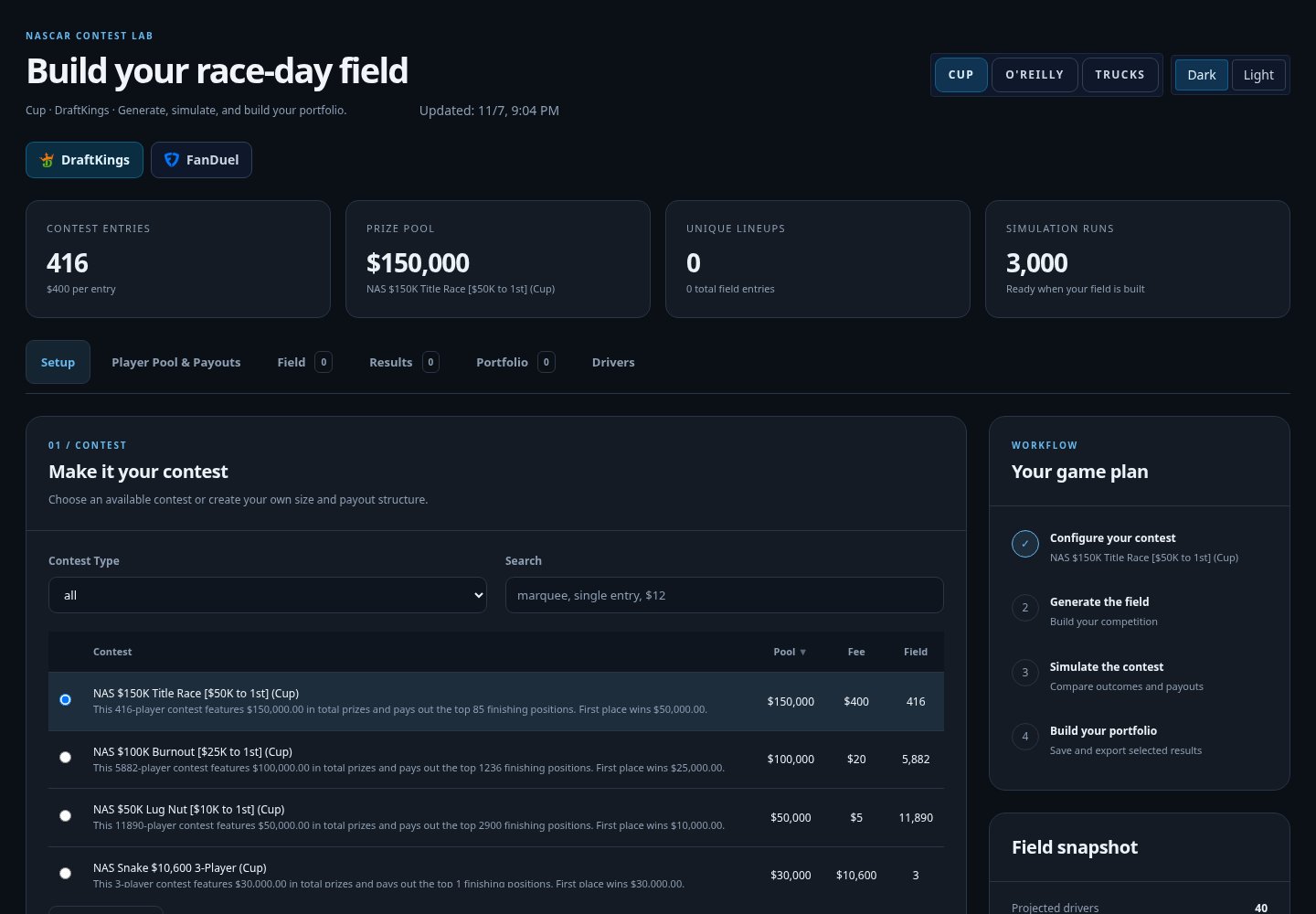
NASCAR · Contest simulator
NASCAR contest simulator: build the field and review a portfolio
Use contest payouts, field assumptions and driver exposure to compare lineup sets for Cup, O’Reilly and Trucks.
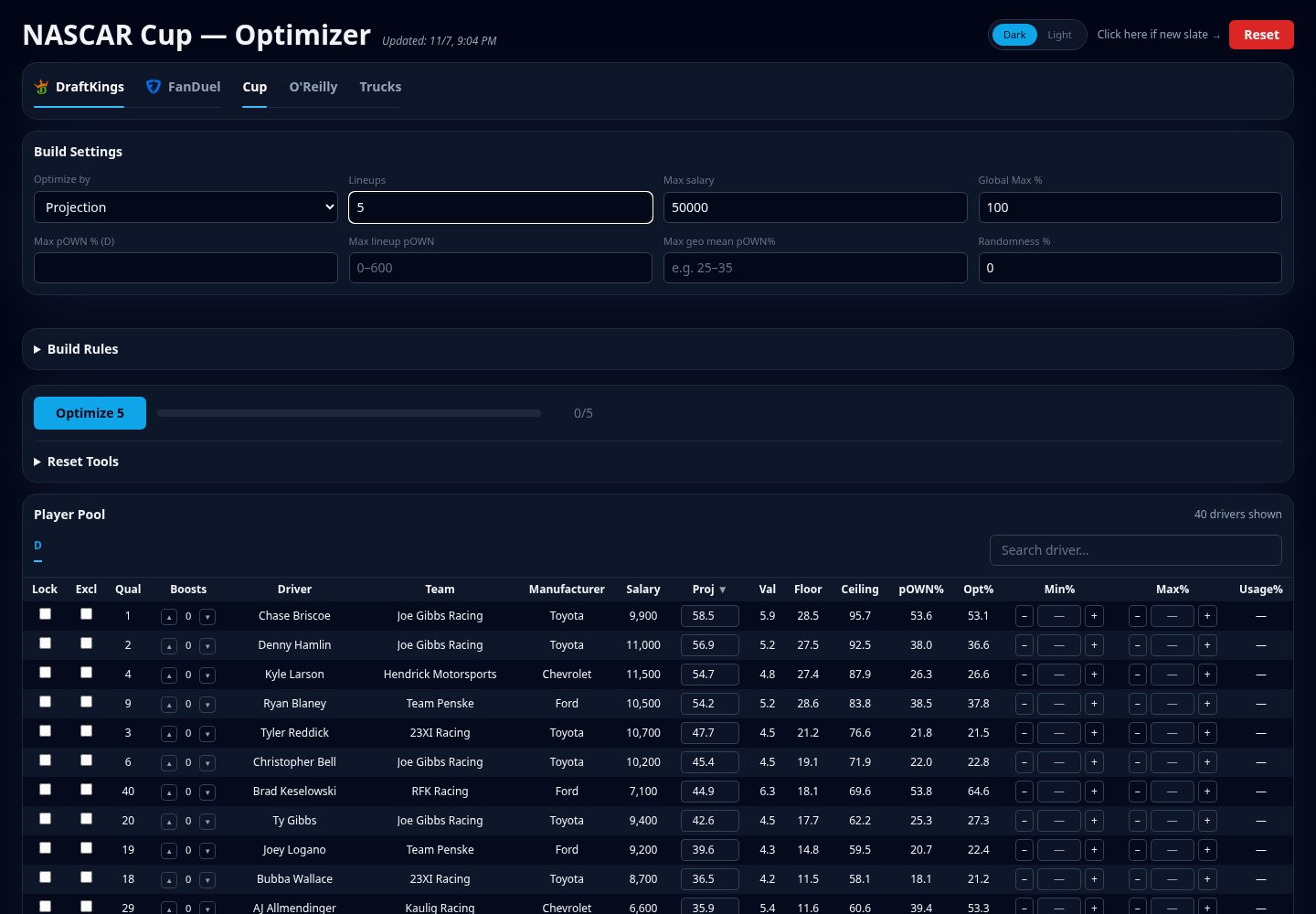
NASCAR · Optimizer
NASCAR optimizer: driver rules, exposure and lineup review
Use the Cup, O’Reilly and Trucks builders to translate race research into driver counts, groups and exposure limits.
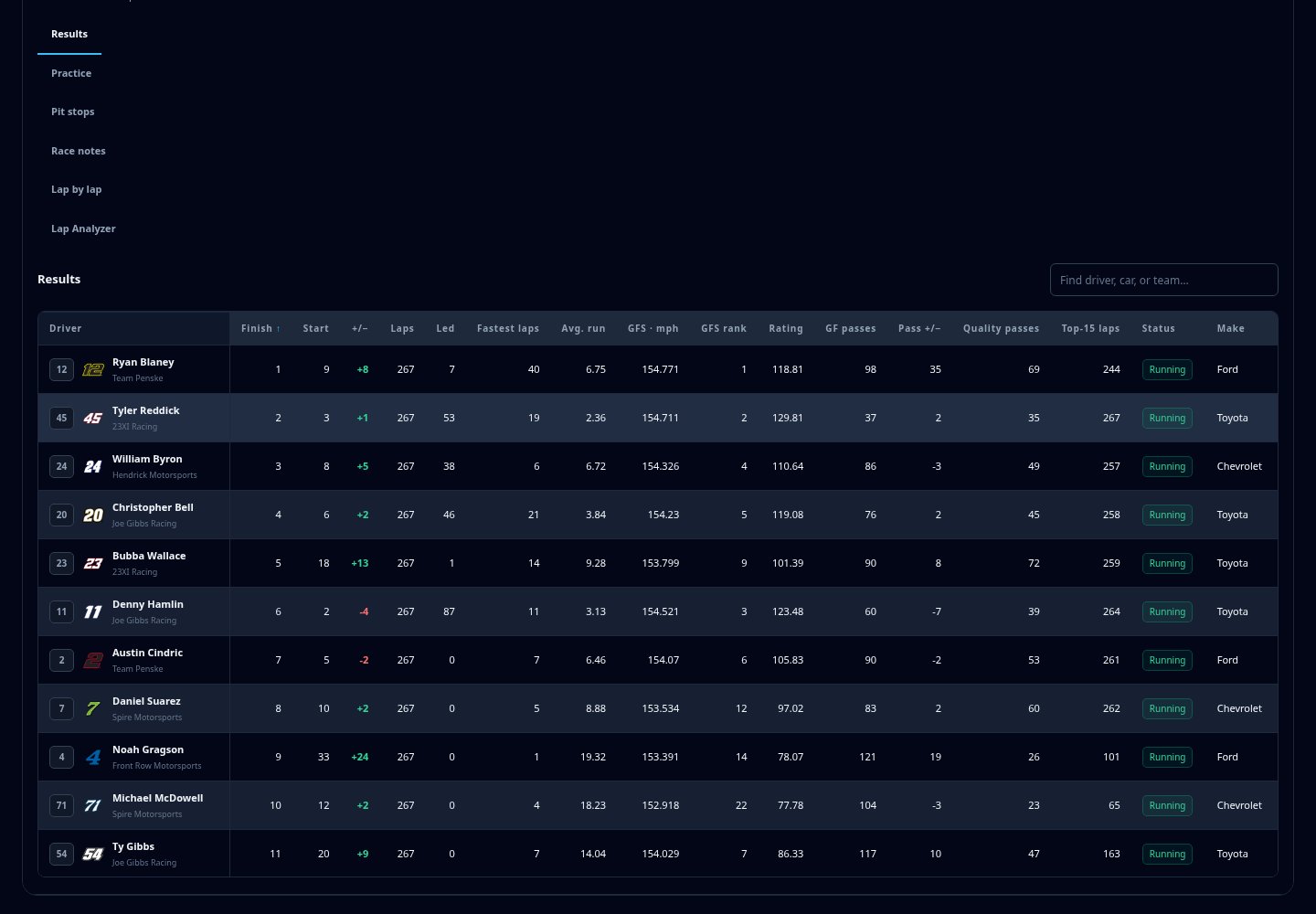
NASCAR · Research
NASCAR research workflow: from track context to lineup review
Use the research pages together so a driver ranking has a reason behind it and a lineup rule has a clear purpose.